Pages

Saturday, May 3, 2014

To be honest, I'm jealous.

A former friend of mine seems to be undergoing a conversion to Christianity. To make a long story short, for almost a year and a half, she was coming to weekly Unitarian Universalist meetings that we held at our home. Then, within the scope of a month or so, she decided she did not want to be friends anymore, joined the community Bible study, and started writing about a conversion of sorts on her blog.

There were many reasons she decided not to be friends any longer, and though it has been frustrating for me, I understand that she was needing to take better care of herself and being friends with me made that difficult for her (for multiple reasons).

Yet, I cannot help but be aware of the mixed feelings that have surfaced about her conversion. In one sense, it has been simply baffling to me that someone could change so quickly. Her new habits, her everyday language, her scripture-quoting, and her participation in Bible studies and VBS has been a complete transformation from the person she presented herself to be during the 1.5 years of UU meetings. 

And, though I do not consider myself to be a Christian, I have always felt as though people need to find what works for them - whether it be Christianity, Islam, Buddhism, Agnosticism.... We are all on different paths to the same destination. Why, then, was I feeling annoyed... frustrated... and, to be honest, a little sad, about her newfound Christian faith?

The answer, I found, is that I am jealous.

Being a Christian would make things so much... easier, sometimes. 

To have a built-in community despite moving around, to have an endless amount of resources for spiritual growth of my own and my children (children's Bibles, devotionals, tv shows, curriculum, etc.), to have children's programs (hello, VBS), and, not to mention, to have convenient answers for many of life's difficulties. 

I'm jealous because almost with the flip of a switch, my friend has been able to jump right into a thriving community the likes of which I desperately wish I could have as well. That is what bothers me: I want what she has been able to get. 

Being honest, and authentic, is tough. It's tough to jump in with an opposing viewpoint when so many around you might think the same way. It's tough to make yourself vulnerable when you admit that you don't have all the answers, or that no, you don't fit into the same box that this friend, and that friend, and that lady down the street fit into. 

Being honest is tough.
Being authentic is hard.
But being something I'm not is simply impossible.

So, even with all my mixed feelings about it, I hope my friend is on a path that brings her more peace, more friends, and more happiness. I'm finding those things too, on this path of my own.

Isn't that what life is all about?

Wednesday, March 5, 2014

Religion around the world: Let's learn about Sikhism

Do you know much about Sikhism? I sure don't.


I know Sikh's wear turbans... and I know they are often confused with Muslims... but that's about it. Terrible, right?

So let's learn more about Sikhism, together.

The Basics:

How many people follow Sikhism? Sikhism is the 5th-largest organized religion world-wide, and has approximately 30 million followers. Most of these followers resides within Punjab, India, and the United States has an estimated 336,000 Sikhs.

How old it is? When was it founded? Sikhism was founded in the 16th century in the Punjab area of what is now India and Pakistan. It was founded by Guru Nanak (1469-1539). "Guru" is the sanskrit word for "teacher," or "master." Nanak was a young boy when he became interested in spiritual matters. He was supposedly fascinated by God and religion, and thoroughly studied Islam and Hinduism. People began to recognize divine qualities in him as a teenager, and around the age of 30, he disappeared for three days. When he reappeared, he declared, "There is no Hindu, there is no Muslim," and he began to spread his teachings. He went on several journeys spanning thousands of miles, and Sikhism was born. Guru Nanak appointed the next successive guru before he died, and following guru Nanak were a total of 10 successive gurus who all added to and reinforced the message taught by the previous guru.

Does Sikhism have a holy text? The primary source of scripture for Sikhs is the "Guru Granth Sahib" (also called "The First Volume). This text is filled with many teachings of the gurus.

Who or what does Sikhism worship? Sikhism is monotheistic, and the concept of God is timeless, shapeless, and sightless. Sikhs believe that before creation, all that existed was God and God's divine order. God willed for the universe to be created, and so it was. 

What does Sikhism require? Sikhism demands that people use ordinary life to become closer to God. Sikhs are to serve God by serving other people, and devote their lives to service to rid themselves of ego and pride.

Where do Sikhs worship? Sikh places of worship are referred to as "Gurdwaras." This may refer to a temple, or to a place in someone's home, in which the sacred text of Sikhism is housed and treated with respect. There are 3 main functions of public Gurdwaras: 1) singing of hymns, 2) teaching and reading of the scriptures, and 3) to offer free community kitchens to visitors from all religions. How cool is that?

The Harmandir Sahib, or "Golden Temple" in Punjab, India - a holy site for Sikhs.


Now, for a few more details....

What do Sikhs believe about God?
  • God can be directly accessed by everyone and everyone is equal before God, no matter race, religion, caste, or gender.
  • God cannot be understood by the human mind, but God can be experienced through love, worship and meditation.
  • God is inside every person, no matter how wicked they appear.
What are the duties of a Sikh? There are three duties to be carried out by Sikhs in order to become closer to God (the ultimate goal of life). These are:
  • Pray: Keep God in mind at all times.
  • Work: Earn an honest living.
  • Give: Give to charity and care for others.
What are the Five Vices? The Five Vices are believed to make people self-centered, and they create distance between ourselves and God. These are:
  • Lust
  • Covetousness and greed
  • Attachment to worldly things
  • Anger
  • Pride
What happens when we die? Like many religions in Asia, Sikhs believe in a cycle of life, death and rebirth (or "reincarnation"). Karma is a factor in our quality of life, and is affected by how well or how badly we treat others. The only way out of the cycle of rebirth is complete union with God.

Why do Sikhs wear turbans or head coverings? The Sikhs have a practice of keeping their hair uncut - for both men and women. Hair is a symbol of holiness and strength, and is part of God's creation. Keeping hair uncut means that one is willing to accept God's gift as God intended. This is also a way for Sikhs to deny pride in their appearance. Sikh men usually wear turbans to keep their hair clean, to cover their head in respect to God, and as an outward symbol of their faith. They also keep long beards because of the belief that hair should not be cut. Women may also wear turbans to cover their hair, but usually accompany this with a chunni (or long scarf worn over their head), or they may just wear a chunni alone.


If you'd like to learn more about Sikhism, most of this information was gained from the BBC's excellent site on Religions. Hope you learned something new. I certainly did!

Monday, February 17, 2014

The "My Promise, My Faith" Girl Scout pin (for UU kids)


My eldest daughter is a Daisy in Girl Scouts. She loves getting new pins and petals for her uniform, and one interesting pin she worked on recently was the "My Promise, My Faith" pin. I knew she would probably want this pin, but I was wary of what it might require. We identify best with Unitarian Universalism, and since there is no UU church on our military base (or in our area at all), we have not talked with our children about "what we are" or "aren't." We try our best to live our ideals and convictions, and have never felt as though we needed to point out what might make us different from others of different religious backgrounds.

So, when I looked up information about what would be required for this pin, here's what I found:
  1. Choose one line from the Girl Scout law. Find a story, song, or poem from your faith with the same ideas. Talk with your family or friends about what the line of the Law, and the story, song, or poem have in common. 
  2. Find a woman in your own or another faith community. Ask her how she tries to use the line of the Law in her life.
  3. Gather three inspirational quotes by women that fit with that line of the Law. Put them where you can see them every day!
  4. Make something to remind you of what you've learned. It might be a drawing, painting or poster. You could also make up a story, or a skit.
  5. Keep the connection strong. Find out if your faith community offers a recognition program for Girl Scouts. Talk with your friends, family, or faith community about what you've learned about your faith and Girl Scouting. Ask them to help you live the Law and your faith. 
And here's what we ended up with:


When we began to look for ideas for our poster, I was at a loss. Unitarian Universalism pulls from all religious traditions, believing there is truth to be found within each one. And there is no creed within Unitarian Universalism that members must believe in order to be considered a UU. When we looked at some of the other troop members' work and ideas (posted within our troop's FB page), every single one of them was doing a Christian project and was using a Bible story for the basis of their project. We could have used a Bible story too, but I wanted to do something different.

I also realized very early on in our project that this would demand quite a bit of help from me. I am a passionate advocate for educating children about other religions, and we have several books around our house that teach our girls about religions, the Bible, and concepts of God. I was quite surprised, then, at how difficult it was for me to describe the idea of "faith" to my 5-year-old. We have always talked about our beliefs as simply that - our beliefs and ideas - and I felt as though discussing with her how we would do a project to tell everyone about our "faith" added a new dimension to "our beliefs." It was the first time I had discussed with her the different labels that people have, and that we would be labeled too. It felt like I was adding complexity to something that previously been just another part of our lives. Does that make any sense?

Anyway... here's how we assembled our poster and tackled this project:

  • We choose the line "Honest and Fair" from the Girl Scout Law. Like I said, most other girls from her troop found a Bible story to use in conjunction with their chosen line from the Law. We decided to use a story from a book we have titled "Buddha at Bedtime." It was the story of "The Dirty Old Goblet" and its lesson was that it is always wise to be honest, because being honest will prevent suffering for you and others. And since UU's don't limit spiritual teachings to the Bible and Christianity, we found a great website where we could search for teachings on honesty from all the world's religions.
  • There are very few UU's around here, so instead of finding a woman in our own faith community, we decided to call my daughter's great-grandmother in the states, and ask her about how she tries to be honest and fair. 
  • We looked up quotes online from famous women about being honest, and found some from Eleanor Roosevelt, Michelle Obama and the founder of the Girl Scouts, Juliette Gordon Low. We included the quote from Eleanor Roosevelt on our poster.
  • We made a poster to show everything we had talked about. On the poster above, you'll see:
    • The line from the Law that my daughter chose to highlight.
    • The line's meaning in her own words.
    • One of the quotes from famous women that we looked up.
    • Several teachings on honesty from the religions of Christianity, Hinduism, Buddhism, Shintoism, and Judaism. 
    • The title of the story we found to go along with the line of the Law, and a drawing my daughter did of the little girl from the story.
    • A painting of "Lupe," the flower who teaches Girl Scout Daisies about being honest and fair.

We took our finished poster to the Girl Scout awards ceremony a couple of weeks ago, where all the posters were displayed, and my daughter received her "My Promise, My Faith" pin. She was excited, to say the least.


Look at that face!
The best thing about this project was the discussion I had with my daughter when we found all those different religions' teachings about being honest and fair. We picked out a few to include, and as I was reading them to her, I asked her if she noticed anything about what all those different teachings had in common. Surprisingly, she DID notice that all those different religions were saying the same thing - that people should always strive to be honest and fair. I emphasized that fact, and then she said this: "Don't people realize that if they would just know they are all teaching the same thing, there is no reason for them to fight with each other?" 

If only it were that simple.

Sunday, February 2, 2014

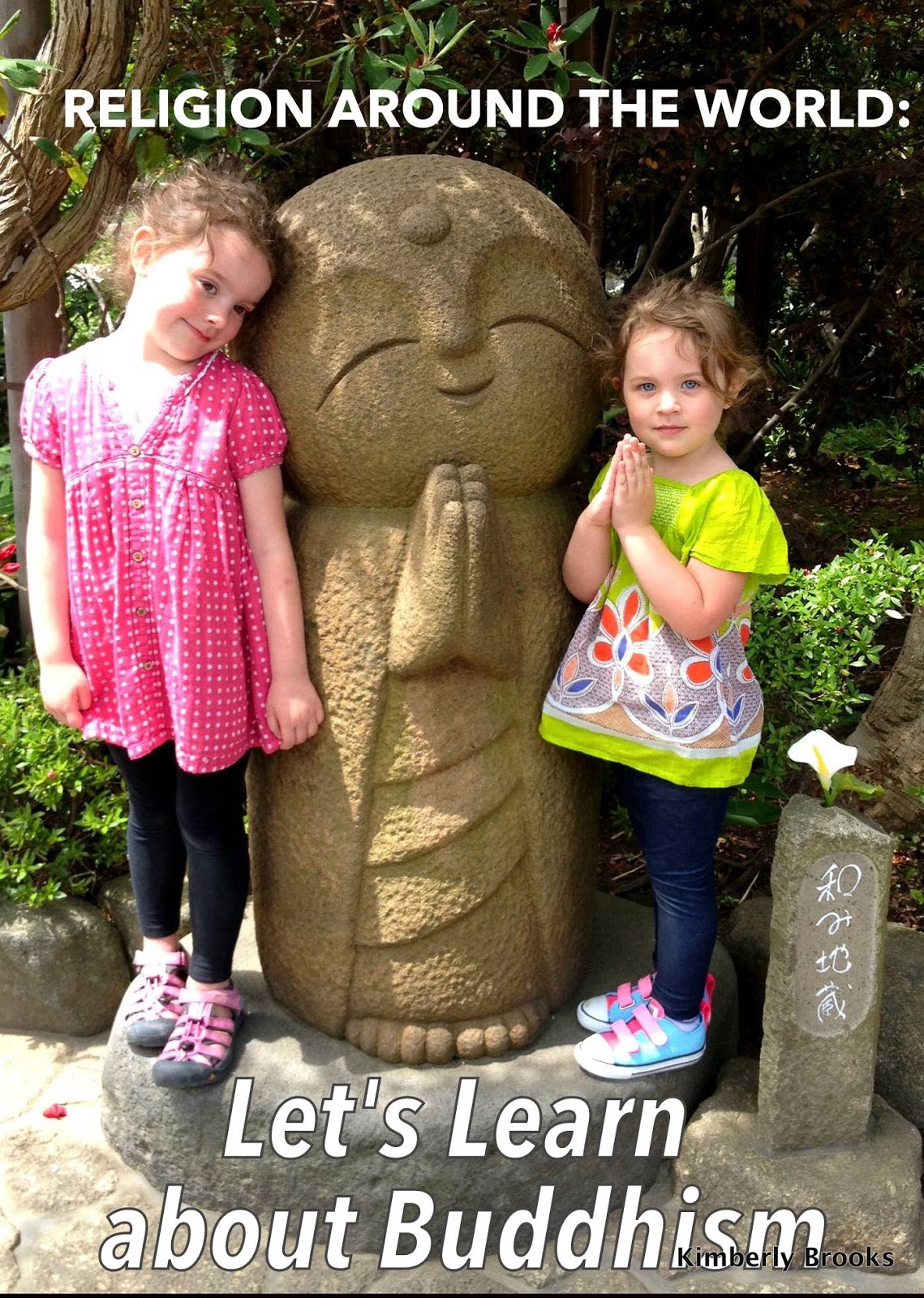
Religion around the world: Let's Learn about Buddhsim


The first post in this series was about Shintoism, a not-so-well-known religion native to my host country, Japan. To follow that post, I thought I'd continue our world religion lessons with Buddhism, the other most common religion in Japan.

I developed an interest in Buddhism in college, after taking an "Eastern Religions" class. And I've always had a special place in my heart for His Holiness the Dalai Lama (spiritual leader of Tibetan Buddhism). But I've been surprised by how much more there is to learn when you're living in a Buddhist country. One of the best things that has happened to me while living in Japan has been the friendship I've cultivated with a Buddhist monk. He has been teaching me meditation, and has helped me host "Introduction to Buddhism" classes for the many foreign military personnel living here. Those classes have been eye-opening for me, and while it would take 400 blog posts to tell you about all the things I've learned, I'm going to try to give you a basic introduction to Buddhism for those of you who may have never been exposed to Buddhism before.

Keep in mind that like Christianity, there are many different sects (or denominations) of Buddhism. So while overall beliefs and practices may be the same, there can also be a lot of differences between Buddhists. In Japan, for instance, Shintoism and Buddhism became tightly intertwined. Shinto and Buddhist beliefs make up a kind of Japanese Buddhism that is slightly different from the basic Buddhism I learned about in college.

But enough talking... Let's learn about Buddhism!

The Basics:

How old is it? The origins of Buddhism began about 2,500 years ago when Siddhartha Gotama, known as the "Buddha" became enlightened around 35 years of age.

The story of Siddhartha is that he was a prince born into a royal family in present day Nepal. Though his father tried to shelter him, when he was 29 years old he realized that there was suffering in the world (sadness, sickness, death) and that wealth/luxury did not guarantee happiness. He left his home and family to explore different religions and philosophies to find the key to happiness. After studying and meditating for six years, he became enlightened. He spent the rest of his life teaching the path to enlightenment until he died at 80 years old.

Does Buddhism have a holy text? The Buddha did not write any scriptures, so everything that makes up Buddhist texts today are the teachings that Buddha's followers heard and wrote down themselves. Before a teaching could be included in the scriptures, it had to be verified by others who heard the same teaching (in other words, one random guy couldn't just make something up and say it was from the Buddha). No one Buddhist text is accepted as sacred and authoritative for every school, or sect, of Buddhism. Each school may place emphasis on the texts or scriptures they feel are most important.

Many scriptures are referred to as "sutras" (the Sanskrit word for "thread"). Some of the most popular and well-known Buddhist texts are the "Pali Canon," the "Heart Sutras," the "Dhammapada," and the "Lotus Sutras."

Who or what does Buddhism worship? When you visit a Buddhist temple, and witness people bowing, praying, and bringing offerings in front of a statue of Buddha, you can't help but assume that they are worshipping Buddha as a god. And this was confusing to me because I always learned that Buddhism itself had no god. So let's clear this up.

The Buddha never claimed to be a god. And Buddhism traditionally does not teach a belief in a diety. But so many non-Buddhists are confused by the golden statues of Buddha and the followers praying in front of such statues. One of the monks attending the "Introduction to Buddhism" class I mentioned earlier explained this wonderfully. He said that the statues of Buddha are much like the statue of Jesus on the cross, or the large cross you'd find at the front of many churches. It is a visual reminder of the Buddha, or the teaching. Followers who walk up to the foot of a Buddha statue and pray or bring an offering, are paying respect to the image or teaching of the Buddha - much the same way a Christian might walk to the front of the church to kneel and pray. It is a place of focus, reverence, and contemplation.

What does Buddhism require? Interestingly, Buddhism does not require conversion for someone to follow the Buddhist path. It's entirely possible to be a Christian and a Buddhist because Buddhism is not only seen as a religion by many, but also a way of life and philosophy. Buddhist principles can be integrated into any spiritual practice. The basic concepts of Buddhism are summed up by the Four Noble Truths, and the Noble Eightfold Path.

Where do Buddhist followers worship? Let's change the word "worship" to "practice," since we've already discussed the absence of a diety in Buddhism. There is no holy day in Buddhism, so Buddhist rituals, ceremonies, and practices can happen any day of the week. Buddhists can have a small altar (consisting of a picture or statue of Buddha, incense, a sacred text, and other Buddhist items) in their home, or they can visit the temple to practice with others.

Now, for a few more details....

What are the Four Noble Truths? The first sermon that the Buddha preached after gaining enlightenment was that of the "Four Noble Truths."

1. Life is suffering. Not only do we feel physical pain, sickness, and eventually, death, but we also suffer psychologically, with fear, sadness, loneliness, anger, jealousy, etc.

2. Suffering is caused by both craving and aversion. We will not find happiness if we desire something other than what we have, or if we try to avoid something we do not want.

3. Suffering can be overcome; true happiness is possible. If we give up useless craving/desire, and live in the present (instead of the past or future), we can become happy and free.

4. The Noble Eightfold Path is the path that leads to the end of suffering.

What is the Noble Eightfold Path? The state of being "awakened" is always available to us. It is not "made" by anything - even the Buddha's teachings. To be awakened is to know our true nature, and most of us go through life being unaware of our true nature. The Noble Eightfold Path is a way to "unlearn" all the conditioned responses to life that prevent us from seeing our true nature.

1) Right View: Understanding reality is the awareness of what is going on both outside and inside of us.

2) Right Thought or Attitude: Just as important as our actions, are our thoughts and intentions.

3) Right Speech: We must always aspire to use clear, truthful, uplifting and non-violent communication.

4) Right Action: We act rightfully (without selfish attachment to our work) and mindfully. And we follow the 5 precepts:
  1. Not killing.
  2. Not stealing.
  3. Not misusing sex.
  4. Not lying.
  5. Not abusing intoxicants.
5) Right Livelihood: Earn a living in way that does not compromise the 5 precepts. The Buddha advised us to find a way to make a living that does not cause harm to others.

6) Right Effort: Use your energies to develop wholesome qualities, and to release unwholesome qualities.

7) Right Mindfulness: To be mindful is to be aware of the present moment with both mind and body. When we are mindful, we are not lost in daydreams, worries, or anticipation.

8) Right Concentration: Often associated with meditation, this part of the path asks followers to spend time focused on one object/mindset. It is said that through meditation, we can be freed from the delusion that we have a separate self (this is the idea of "interconnectedness" that the Dalai Lama so often speaks of).

What happens when we die? There are different ideas about what happens after death, depending on what particular school of Buddhism you adhere to. However, most Buddhists would agree that death is not the end of our mind, or spirit, but simply our body. Some schools of Buddhism believe in reincarnation, and others believe in rebirth in different realms, or heavens.

My friend, Fujio san, who is a Buddhist monk, told me once that many Buddhists are not concerned with knowing exactly what will happen after death because the most important concern is living a mindful life in the present moment. If we are concerned about what will happen in the future, we are not being mindful of the present.

If you'd like to learn more about Buddhism, be sure to check out Buddha Net. Also, if you'd like some books to read, there are many good books by Vietnamese monk, Thich Nhat Hanh that are easy for Westerners/Non-Buddhists to understand and follow. Most of the information here was gained from Buddha Net. 

Do you have any other questions about Buddhism? Did you learn something new? 

Sunday, January 12, 2014

What is the nature of God? Is God just?

Photo source: Wikipedia

A friend of mine posted this quote on Facebook the other day:
“Live a good life. If there are gods and they are just, then they will not care how devout you have been, but will welcome you based on the virtues you have lived by. If there are gods, but unjust, then you should not want to worship them. If there are no gods, then you will be gone, but will have lived a noble life that will live on in the memories of your loved ones."
Naturally, there was a bit of discussion on this post about the nature of God. For example, here was one [part] of a response:
"Wouldn't a truly 'just' God require either perfection or some debt to be paid to establish a right standing before Him? Unless, of course, the author of the quote actually meant 'lenient' instead of 'just.' I'll have a hard time wrapping my head around the idea that a just God would allow Himself to accept 'but I tried hard' without laughing at us with pity... The same as an earthly judge would if I offered as my defense to a speeding ticket that I hadn't hurt anyone and that I have otherwise been a good citizen. Those facts --while admirable-- don't erase the penalty for my error/crime."
I know a LOT of people that understand God this way. And for most of my life, this was my own understanding of God. But not anymore.

I remember one particularly nagging question that always bothered me when we'd talk about "the unsaved" at church: "What if some woman in a remote village in Africa never hears the Gospel? Would a loving and 'just' God send her to hell?"

And the answer I always, ALWAYS, came up with, was, "No." 

I have struggled a lot over the years, particularly with understanding what God is, and the nature of God. First of all, I don't believe we will ever be able to come close to describing what God is.
"So when we talk about God we're using language, language that employs a vast array of words and phrases and forms to describe a reality that is fundamentally beyond words and phrases and forms." (Rob Bell, "What We Talk About When We Talk About God")
I have a feeling I will always be tweaking my explanation, or view, of God and I don't really think it matters to anyone but me. God is so impossible to describe that I doubt he/she/it cares much about how right we are. You can believe God is an energy, a spirit, or an old man perched on his throne in the clouds. I think all that matters is that you have some way of imagining God that works for you. That feels right to you.

The more important matter, I believe, than describing God, is knowing God. 

And here's where things get tricky, and I'm sure to make some people uncomfortable.

Despite the different ways we have of describing God, and telling people exactly what we think God is, God's essence is unchanged. God can go by any name, and still be God. Call him/her Allah, the Divine, Yahweh, Sat Nam, or Joe, and you won't be changing the essence of God, but just what you call him. So, I believe that God can be called all these different things, among all these different people, and all these different faiths, and we're still talking to, and getting to know, the same God.

Which brings me to this startling revelation: that there is more than one path to God. 

Which then brings us back towards the original question at the beginning of this post: What is the nature of God? Is God 'just'?

When I think about my children, there is absolutely nothing on Earth that they could do to make me stop loving them. They could murder someone, or 100 someones, and I would still love them. Would I be angry? Sure. Heartbroken? Definitely. Disappointed? Immensely. But the love would still be there, even if buried deep down beneath it all.

Isn't the love of God supposed to be even greater than that? If I couldn't banish my children to Hell for all eternity - even for murdering someone - then how could God do the same to millions of people?
"Have billions of people been created only to spend eternity in conscious punishment and torment, suffering infinitely for the finite sins they committed in the few years they spent on earth? [...] Is God our friend, our provider, our protector, our father - or is God the kind of judge who may in the end declare that we deserve to spend forever separated from our Father?" (Rob Bell, "Love Wins")
"Could God say to someone truly humbled, broken, and desperate for reconciliation, 'Sorry, too late'? Many have refused to accept the scenario in which somebody is pounding on the door, apologizing, repenting, and asking God to be let in, only to hear God say through the keyhole: 'Door's locked. Sorry. If you had been here earlier, I could have done something. But now, it's too late." (Rob Bell, "Love Wins")
Hell, as some terrible place full of punishment, pain, and torture, is not compatible with what I believe to be the nature of God. I believe God wants everyone to be awakened, to live more conscious, loving lives, and that God wants to pull humanity forward, closer towards all that God is and intends for us to be. And, for me, believing that there is only one way for God to do this - through ONE religion/doctrine/dogma - puts limits on a limitless God.

So I don't know how God will reach everyone or when it will happen, but I certainly don't put it past him.
"Restoration brings God glory; eternal torment doesn't. Reconciliation brings God glory; endless anguish doesn't. Renewal and return cause God's greatness to shine through the universe; never-ending punishment doesn't." (Rob Bell, "Love Wins")

Thank you for reading if you've gotten this far. This is a very complicated subject and one that I have been considering writing about for the past week. I'd love to hear some of your thoughts. 

Wednesday, January 8, 2014

Living in the tank: Why sometimes it's tempting to hide from the world.


I recently purchased a book from Amazon: "The Book of Awakening: Having the Life You Want by Being Present to the Life You Have" by Mark Nepo. I got it because one of my favorite parenting podcasts (shoutout to Zen Parenting Radio!) mentioned it and said it was in a format in which you read a little something each day of the year. I thought it would be great to have a little pick-me-up or thought-for-the-day each morning, so I bought the Kindle version.

It's amazing when the universe sends you a great, big "Hello!" or "Yes, I'm right here with you." The daily reading for this morning, January 9th, couldn't have been more well-timed.

Yesterday, I found myself feeling a bit weighted down, or overwhelmed, by the world. Life is hard. Even if you have all of your basic needs met, extra money... an "easy" life, there always seem to be things that are difficult to deal with. There is always something that demands our energy.

And sometimes, I just want to hide from it all. It's too difficult.

Today's reading was about fish who were moved from their tank to a bathtub while their tank was being cleaned. Instead of swimming in this giant, new body of water, the fish stayed huddled together in an area of tub the same size as their tank.
"Life in the tank made me think of how we are raised at home and in school. It made me think of being told that certain jobs are not acceptable and that certain jobs are out of reach, of being schooled to live in a certain way, of being trained to think that only practical things are possible, of being warned over and over that life outside the tank of our values is risky and dangerous. 
It makes me wonder now, in middle age, if being spontaneous and kind and curious are all parts of our natural ability to swim. Each time I hesitate to do the unplanned or unexpected, or hesitate to reach and help another, or hesitate to inquire about something I know nothing about; each time I ignore the impulse to run in the rain or to call you up just to say I love you - I wonder, am I turning on myself, swimming safely in the middle of the tub?" - Mark Nepo
I was swimming in my tank yesterday. I didn't want to leave and go out into the world because it just seemed.... unswimmable.

Creating and nurturing friendships, raising good children, injecting more good into the world, becoming part of my community... it all takes so much energy and to be honest, it's really scary sometimes.

This is exactly the reason I have always felt a connection to something greater than myself.
"From lying to explosive anger to addiction to the inability to forgive to overwhelming helplessness in the face of tragedy to the constant, gnawing anxiety that won't go away to the haunting sense that you're not good enough no matter how hard you work and what you achieve, when we're talking about God, we're talking about the very real sense we have that we do not, on our own, have everything we need and we are not, on our own, everything we could be." (Rob Bell, "What We Talk About When We Talk About God")
I believe we were all made to swim in the ocean, but at times, doing so requires that we draw upon an energy that is greater than our own.

God helps me leave my tank.

So when I'm feeling weighed down by the world, I want to try to remember that I don't have to tackle everything on my own. I was made to swim. And there is an endless source of hope, love, and wisdom to tap into if I'm willing to do so.


Thursday, January 2, 2014

On why religion and spirituality need each other.

iStock/Pete Will
We've all heard the phrase, "spiritual, but not religious." In fact, I have felt comfortable being placed in this category for the past decade. Being spiritual, for me, meant feeling a connection to something greater than myself while not feeling comfortable within a religious community. I knew there was more to life, but I didn't believe I needed religion to find it. This path led me to a more peaceful and confident place than I ever found by going to church. And over the years I've realized that my religion was missing one incredibly important thing for me - the thing that would have been a game-changer for my willingness to stay there: my own spirituality. 

In a recent Pew report, nearly 1 in 5 Americans described themselves as "spiritual, but not religious." Researchers found that for most religiously unaffilated participants in the study, "their views of churches and other religious organizations are decidedly mixed. A majority agree that religious organizations strengthen community bonds and play an important role in helping the poor and needy. But most also say that religious organizations are too concerned with money and power, too focused on rules and too involved in politics." Did you hear about the German bishop who installed a $20,000 tub in his home? Not hard to see where some of that frustration with religion/money/power comes from.

Despite the apparent divide between the spiritual and religious, these two words weren't always used exclusively. 
"Before the 20th century the terms religious and spiritual were used more or less interchangeably. But a number of modern intellectual and cultural forces have accentuated differences between the 'private' and 'public' spheres of life. The increasing prestige of the sciences, the insights of modern biblical scholarship, and greater awareness of cultural relativism all made it more difficult for educated American to sustain unqualified loyalty to religious institutions. Many began to associate genuine faith with the 'private' realm of personal experience rather than with the 'public' realm of institutions, creeds, and rituals. The word spiritual gradually came to be associated with a private realm of thought and experience while the word religious came to be connected with the public realm of membership in religious institutions, participation in formal rituals, and adherence to official denominational doctrines." (Fuller, Robert C.)
Spirituality became something that people could do on their own, while religion was something that people did together. This is where I believe spirituality trumps religion. Spirituality is uniquely personal. It's the heart and soul of what we are as human beings. It's what we know - in our core - to be our truth, and it's what we feel when we are witness to miraculous moments. That gnawing feeling that we are a tiny part of something very grand. 
"Spirituality exists wherever we struggle with the issue of how our lives fit into the greater cosmic scheme of things. This is true even when our questions never give way to specific answers or give rise to specific practices such as prayer or meditation. We encounter spiritual issues every time we wonder where the universe comes from, why we are here, or what happens when we die. We also become spiritual when we become moved by values such as beauty, love, or creativity that seem to reveal a meaning or power beyond our visible world. An idea or practice is "spiritual" when it reveals our personal desire to establish a felt-relationship with the deepest meanings or powers governing life." (Fuller, Robert C.)
I'm sure many people who consider themselves religious are up in arms over my saying that spirituality trumps religion. However, I'm not saying that being religious can't be powerful, transformative, and life-changing. I just have this sinking feeling that there are many religious people who do not feel an innate connection with God. They do not feel loved and cherished by the divine. ...But they DO go to church. They do perform religious rituals. They do consider themselves part of a religious community. And they are going through the actions of religion without really feeling connected to that which religion was made to connect us to. 

You can be spiritual, without being religious. And you can be religious, without being spiritual. Which is worse? 

One of my favorite people, the Reverend Ed Bacon, taped this interview with Oprah for Super Soul Sunday back in 2011. Listen to what he says about being spiritual and being religious.


To be spiritual is to be on a search to know God. Whether you've been going to church your whole life or haven't ever stepped in one, religion will not transform your life until your heart is open to spirit - until you realize that you are a spiritual being having a human experience. 

So it's great to be spiritual, right? But wait.... 

"Spirituality without action is fruitless and social action without spirituality is heartless." - Rev. Ed Bacon

Too often, being "spiritual, but not religious" keeps us from being in community with others. If we feel connected to God, or the Divine, don't we want to share that with others? And I don't mean in an evangelical sense (heck no!), but in the sense that the love and good energy we feel can radiate outward to those around us. A connection to God naturally fills us with compassion, love, and goodwill toward others. And while we can spread these things on our own, just think of how much more we can accomplish when we work with others?
"Spirituality is an emotion. Religion is an obligation. Spirituality soothes. Religion mobilizes. Spirituality is satisfied with itself. Religion is dissatisfied with the world. Religions create aid organizations; as Nicholas Kristof pointed out in a column in the New York Times two years ago: the largest U.S.-based international relief and development organization is not Save the Children or Care, it’s World Vision, a Seattle-based Christian group." (Rabbi David Wolpe, TIME magazine)
I would be willing to bet that for every kind of spiritual person out there, there is a community somewhere that would welcome you with open arms. Religious communities NEED you. And, it's quite possible you need them. Being part of a community puts us into an arena with others, challenging what we have held to be true. We will never know all the answers with 100% certainty, and communities can help us to continue our search with new perspectives and possibilities. Though I don't feel like anything is a perfect fit, I have been able to find a home within the Unitarian Universalist community (www.uua.org - yep, shameless plug) where I feel like my spirituality is nurtured. I want to be part of a community, and I want my children to know that they are part of something larger than themselves. These days, I might describe myself as "spiritual AND religious." For me, they are becoming one in the same. 

I'm not so sure I've made sense of all this spirituality and religion stuff - it's obviously a tricky subject. But I hope I've gotten your wheels turning a bit. What do you think? I'd love to hear your thoughts.

Wednesday, January 1, 2014

Religion around the World: Let's Learn about Shintoism


To kick off the New Year, I thought I'd highlight the Shinto religion as the first in a monthly series called "Religion around the World." Shintoism is native to Japan, and  New Years is a big occasion at Shinto shrines throughout the country. I knew relatively nothing about Shintoism before moving to Japan, but it's a very interesting religion. 

Let's go over the basics, shall we?

How old is it? Shintoism is indigenous to Japan. It is so old that there is no founder, and it's rituals and beliefs date back to prehistory. It was called "Shintoism" or "Way of the Gods" after Buddhism came over to Japan around 550 CE, so as to avoid being mixed up with the new Buddhist ideas. 

Where is it practiced? Shintoism is practiced only in Japan, making it very unique.

Does Shintoism have a holy text? Nope. There are, of course, legends and stories written down but none that are used as canonical scriptures.

What or who does Shintoism worship? There is no God in Shintoism, but instead, a belief in spiritual beings or powers, called "Kami." 

What exactly are Kami? Kami are gods, spirits, ancestors, and natural forces that are around us all the time. They are concerned about human beings, and if we treat them properly (here's where all the rituals come in) they can intervene to help us have a happy life. Virtually everything contains a kami - the mountains, the trees, the ocean, the sky, rivers, etc. Even people who achieved great things in life can become kami after their death. 

What does Shintoism require? Shintoism does not require its followers to adhere only to Shintoism, and as such, many Japanese practice both Buddhist and Shinto rituals and traditions. Shintoism teaches ethical principles, but does not have strict commandments. Followers are asked to practice rituals that allow human beings to communicate with Kami.

Where do Shinto followers worship? Shrines are places designed to facilitate the interaction of humans and kami. Shrines are built to house kami, with a gate (called "torii" in Japanese) that separates the ordinary world from the sacred area around the shrine. Families may also have a small home shrine, inside their house, that acts as a substitute for a larger shrine on a daily basis. It is believed that no matter the size or location of a shrine, that the kami literally dwells there and the shrine must be treated with the utmost respect. 

A "torii."
Now, for a few more details.

What are some key Shinto teachings? 

  • Human beings are born pure. Shintoism teaches that human beings are born inherently good, and that we are all connected to the divine soul. 
  • Harmony is central to life. In Japan, "wa" means harmony, and in order to be happy and productive, humans must live a harmonious life. Kami's help humans achieve this.
  • Our deeds either create impurity or purity in our lives. Shinto rituals help us to cleanse ourselves of impurities. 
  • Shintoism does not differentiate between our world, and any other supernatural worlds. Everything - human beings and spirits - coexist. 
  • There are no moral absolutes. Did you get that? NO MORAL ABSOLUTES. Whether or not an action or thought is good or bad depends on the context: circumstances, intention, purpose, time, location, etc.
  • Shintoism isn't overly concerned with an afterlife. It is concerned with life in the here and now. 

What is a popular Shinto festival or occasion? 

New Year's! Shrine attendance is huge on New Year's Day, called "Oshogatsu" in Japanese. The Japanese visit shrines to thank kami, ask for kamis' blessings in the new year, and to make resolutions in front of the kami. Popular shrines in Japan may expect hundreds of thousands - sometimes even millions - of visitors during New Year's week.

Photo credit: Alafista

One of the things that I find so interesting about Shintoism is its integration with other religions. Many Japanese are both Buddhist AND Shinto. When babies are born, they are blessed at a Shinto shrine. When people die, they are given a Buddhist funeral. For the Japanese, Shintoism has become a way of life and it does not require a profession of faith for one to be considered Shinto. As an American who has so often seen the inability of religions to live and work together within America, I admire the seamless intermingling of Shintoism with other beliefs and religious practices.

I hope you learned a thing or two about Shintoism. Most of this information was taken from one of my favorite educational books for children, "What Do You Believe?" from DK Publishing, the BBC informational site on Shinto, and Wikipedia, if you'd like to learn more.

What do you find most interesting about Shintoism? Is there anything else you'd like to know? 

Monday, December 30, 2013

Plans for the New Year


We've had a busy December with travels to Hiroshima and family coming in for Christmas. Now that things have settled back down, there are only a couple of days left in 2013 and I've been thinking a lot about what I want for myself and this blog in the upcoming new year.

I don't really know what I'm doing here, in this online space, but I do know that part of me yearns to be here. I have lots of ideas floating around in my mind... so many that I often find it difficult to stay with a single topic long enough to complete a post. I think it might be helpful (for you? or maybe just for me?) to outline the kinds of topics I'm thinking of taking on here at The Cultivated Faith. Of course, suggestions are welcomed as well. :)

Book Reviews

If you see me at the library, you'll most likely find me in the spiritual and religious section. I have stopped apologizing for liking these kinds of books... It's just who I am. I have a long list of books I'd like to read within these categories and that list seems to grow longer every day. So, I thought it might be nice for me to post book reviews of the books I've been reading. Maybe even to blog throughout a book if I find a particularly good one. The first up on my list? "Love Wins" by Rob Bell. I read this book on my Kindle, but bought a hard copy that finally came in the mail. Because I had borrowed the Kindle version, all my notes are gone so it looks like I'll have to read it again and highlight the hard copy. Darn. :) I have LOVED this book, and can't wait to write about it. You're welcome to get a copy and read along with me - I'd love to hear your thoughts about it.

World Religion Spotlights

I minored in Religious Studies, and I still learn new things about the world's religions every day. I'd like to shine a light on one of the world's religions, maybe once a month, with information for adults who are interested, as well as resources for teaching children. We live in a global community, people. We need to learn more about each other.

Religious Leader Spotlights

There have been many, many people to influence the world's spirituality and religion. I'm talking religious leaders, thought-reformers, activists, missionaries, and everyday people who found themselves doing something miraculous. Let's learn about them! And let's teach our children about them too.

Parenting Dilemmas

Do you have children who ask tough questions? Are you clueless about how to answer them? Me too! It's hard to navigate questions about death, God, heaven, and hell, when you don't subscribe to a singular religion. And it's difficult even when you do! I hope to tackle some of these subjects by being honest about my own struggle to find answers, as well as by offering some suggestions on talking about these topics with our children.

New Ways of Thinking

I hope that every reader who happens upon or searches for this blog is cultivating their spiritual lives.  I believe that we always have more to learn, and I want to push my readers to continue their spiritual growth rather than letting it stagnate. We are on Earth to expand our consciousness, to live a more awakened life, and to fully realize that we are spiritual beings having a human experience. I don't ever expect to know all the answers, but I sure do enjoy the search for them. On this blog, you can expect honesty, thoughtfulness, and a genuine desire to better understand those who may be different than me. This will not be a place for judgement and condemnation. There's enough of that in the world. It's high time we chose a different path.

Please let me know if you have suggestions for this blog. I'd love to hear them.


Monday, December 9, 2013

Whatever your reason for Christmas, I simply hope you have one.


"Christmas is when you celebrate the birth of Jesus." That's what my oldest daughter told her sister.

Even though we don't really consider ourselves a Christian family (at least in the same sense that other Christian families would probably describe themselves), I want my children to be religiously literate. And I want them to understand the interconnectedness of all religion and spiritual life. So, we bought a nativity last year (I highly recommend this one) and I have devoted more energy this year to making sure they understand the nativity story and the meaning that so many other families give their Christmas holiday.

But hearing my daughter say so matter-of-factly that Christmas is the celebration of Jesus' birthday made me feel a bit uneasy.

I'm not here to debate whether or not Christmas IS Jesus' birthday, or whether or not it should be celebrated as such. I am, here, however, to figure out how these ideas fit into my own family. One of the things that bothers me most about religion is the fact that so many people believe they know the right answers. I have always said that when it comes to my children, I will not care what religious or spiritual beliefs they hold. I just don't want them to grow up believing that everyone else should believe exactly as they do.

"If you've got all the answers, then don't call what you do faith." - Brene Brown

So because we've read the nativity story in a children's Bible story book, and we've watched a beautiful narration of the nativity story (highly, highly recommend this video - FREE with Amazon Prime), and we've talked about the birth of the "light of the world," my very literal 5-year-old came to believe that this was the meaning of Christmas. Who can blame her? 

What's important for me, with children ages 5 and 4, is that Christmas has some sort of meaning to them. 

Regardless of what you believe, it's important to believe in something -  be it your religion, the Universe, or simply human compassion. With all it's different meanings, traditions, and historical influences, Christmas provides an opportunity for many of us to come together during an often gloomy and cold time of year (depending on where you live, of course!). From the earliest records we have of civilization, humans have been celebrating things at this time of year. Most common was the winter solstice - the shortest day of the year, which meant more sunlight in the days to come. Humans have always felt a desire to come together and celebrate. 

So whatever your reason for Christmas, I hope this season is full of joy and love for you and your family. Christmas, for me, is a time to take notice of how wonderful it is to have family - near and far - who love us. It's a time to shower the people I love with gifts. It's a time of warm food with friends, soft lights on evenings when the sun sets too early, and a reminder that the world is a good place. And whether my children believe it literally or figuratively, it's a time to celebrate a special light that came into the world many, many years ago. 

I just want my children to believe in something. 

“As long as you have life and breath, believe. Believe for those who cannot. Believe even if you have stopped believing. Believe for the sake of the dead, for love, to keep your heart beating, believe. Never give up, never despair, let no mystery confound you into the conclusion that mystery cannot be yours.” ― Mark Helprin, A Soldier of the Great War

What do you want your children to believe in during this holiday season? I'd love to hear your thoughts.

Monday, December 2, 2013

Truth in the Tinsel: The Light of the World

I happened upon an Advent ebook called, "Truth in the Tinsel: An Advent Experience for Little Hands." This is a book for Christian families, with the purpose of teaching children about "the greatest story ever written and the greatest gift ever given - God's own Son, Jesus the Christ!" While the premise of the book doesn't fit like a glove for my own family, I think it is a great resource. However, if you're a bit like me and want to tweak the book to better fit your own values and beliefs, I'm going to give it a try and will post my alterations here. I will probably not be doing every activity and craft during advent, and let's be honest - it may completely fall by the wayside if I'm feeling overwhelmed with holiday obligations. No activity, tradition, or outing is worth a stressful and irritated Momma. 

So, here is the topic for Day 1: The Light of the World. How could I not do this one when I wrote just yesterday about this very topic? 

The image of an inner light permeates many world religions. In talking with my children about the "light of the world," this Christmas, I'm going to make sure to emphasize that this idea is shared by lots of people all over the world.

We will watch a video from Brain Pop about the festival of Diwali. "Diwali, or Dipawali, is India's biggest and most important holiday of the year. The festival gets its name from the row (avali) of clay lamps (or deepa) that Indians light outside their homes to symbolize the inner light that protects us from spiritual darkness. This festival is as important to Hindus as the Christmas holiday is to Christians." (National Geographic)

We will talk again about Hanukkah and the ritual lighting of candles each night. The Jewish Torah, or what Christians refer to as the Old Testament, says in Proverbs 20:27 "A candle of God is the soul of man." 

Then we will read Matthew 5:14 where Jesus said, "You are the light of the world." 

The light is in us. 

Jesus, then, is important to remember at Christmas because he brought in him a new kind of light - a brighter light - and spent his life trying to remind us of the light residing in ourselves, and how to make that light stronger. 

I will talk with my kids about how they feel when they're in darkness. Is darkness scary? Are things hard to see? How do they feel when they find a light, or turn on a light? Can they see things more clearly? 

Jesus wants them to always remember that they have a light inside of them. And the more attention we give that light, the more light we'll spread to others, and the more connected we'll become to God [or insert the word that works for you here - the Universe, the Divine, etc.], the source of all light. 

We will wrap up our lesson about our inner lights by making a light ornament, found in the "Truth in the Tinsel" ebook. 
Photo taken from here. 

If you'd like to purchase your own copy of "Truth in the Tinsel", please head here. 

Do you have any suggestions to add to this lesson and activity? I'd love to hear them!

Sunday, December 1, 2013

The Light of the World


Most every Sunday, a small group of people gather in my home for some coffee and community. We all met each other because of an interest in the Unitarian Universalist church, and we usually spend our Sunday mornings drinking coffee, listening to a podcast, and having some discussion afterwards.

This morning, we listened to a podcast by Barbara H. Gadon, Interim Senior Minister at First Unitarian Church in Chicago. It was titled "The Light of the World," and, not surprisingly, was about the upcoming celebration of Jesus' birth and that saying we hear so often that He is the "light of the world." 

In Matthew 5:14, Jesus said, "You are the light of the world. A city built on a hill cannot be hidden.  No one after lighting a lamp pus it under the bushel basket, but on the lamp stand, and it gives light to all the house. In the same way, let your light shine before others, so hat they may see your good works and give glory to your father in heaven." 

For much of my life, I heard something said about Jesus being the light of the world and I got the impression that Jesus was a light sent to our dark world. But if you read that passage above from Matthew, it's very clear that Jesus was telling us that the light has been here all along. "You are the light of the world." WE are that light. We all posses that divine spark. 

"'The light of the world'" was a common expression in Jewish tradition at that [Jesus'] time. Rabbis taught that God was the light of the world, or that the Torah or the tribe of Israel was the light of the world. So saying, 'You are the light of the world' to ordinary people, most of whom were poor and struggling, was something radically different. Different ways to understand this might be: You are like God. Or, you have God in you. Or, your heart is as important as the Torah. It would have startled most people; it would have enraged the priests as blasphemy. It would also have given people hope." - Barbara H. Gadon

In the way I used to intepret it, "the light of world," had a feeling of exclusivity to it - that only those people who took Jesus as their savior could have the light in their life. That Jesus was the only light. But I don't think that's what Jesus ever really intended. I believe Jesus was sent as a sort of reflection of the light we already posses - a way for us to see what living IN the light, WITH the knowledge of the light, can look like. Jesus pointed the finger not at himself, but at all of us.

"He was speaking to the rest of us. You, whose marriage failed, or who remained single in a world where people are expected to be married - you are light. You with a jailed child, you are light. Your child is, too. You who work at a job you hate, you who lost your job -- you are light. You are light when your don't like yourself very much, when you have failed. That's the miracle of the light - God in you - it's still there and it can even be there against your will." - Barbara H. Gadon

The brilliance of His light was, and still is, something to aspire to - a deep, out-of-this-world, connection with God. I believe there have been many spiritual teachers throughout time who lived in such a way that the light of God was amplified to those around them. And Jesus was one of the best examples. 

So this Christmas, I will teach my children about the "light of the world." I will teach them that this light is already inside them - inside everyone - and that they have within them the ability to make their light shine, or to keep it hidden away. Jesus gave instructions to "let your light shine before others, so that they may see your good works and give glory to your father in heaven." This teaching can apply to everyone, no matter who they are, and no matter what they believe. I want my kids to learn about Jesus so that they can learn from one of the greatest lights that has ever shown. I want them to learn to use their light to create connection with something greater than themselves. That's what we'll be celebrating on Christmas - the light of Jesus that helped us to see the light in ourselves. 

How do you celebrate or remember "the light of the world?" How do you teach this to your children?


Sunday, November 24, 2013

We all have someone to give thanks to.


I've been thinking a lot lately about how Thanksgiving is quickly approaching. (Who can't help but think about it when there will be lots of cooking and gatherings involved?) Specifically, I've been thinking about how families give thanks on Thanksgiving, and who exactly they're giving thanks to. I would wager that the vast majority of families celebrating Thanksgiving in the United States will be praying before their meal, giving thanks to God just like the Pilgrims did so many years ago. But what if you are not a religious family? What if you aren't sure what - if anything - is out there to pray to?

No matter what your belief about God, I think there is something to be said for taking a moment from the busyness of life to cultivate a sense of thanksgiving. 

Personally, I do believe in something greater than myself - a "God" for lack of a better word. And no matter what anyone calls it, its essence is never changing. Call it Allah, God, the Divine, the Universe, or the laws of physics, it simply IS. And taking a moment to pay attention to what IS, to cultivate a sense of connectedness with others, and with the world around us, can only be good.

In Japan, it is customary to say, "Itadakimasu" before each meal. And while it's possible that many people say it out of habit, without giving much homage to its traditional meaning, it has become a favorite word of my own. Literally, it means, "I humbly receive." But Japan has a strong Buddhist background, with an emphasis on the respect of all living things, and that one simple word expresses thanks to the plants and animals who gave their lives for the meal, as well as the farmers, hunters, and gatherers, who made the meal possible. It is quite humbling to reflect for a moment on how far that food traveled to get to my plate, and how many people had a hand in its delivery.

Whether you believe in a God or not, none of us lead the lives we do independently of others. To think that we are successful solely because of our own hard work or good deeds is an illusion. We were born because of the work of our mother's body. We were kept alive by food that was cultivated, harvested, delivered and purchased for us. The clothes we wear were made by someone else's hands. You are able to read the words on this page because a teacher somewhere spent his or her time and energy teaching you how to read.

"We don't accomplish anything in this world alone ... and whatever happens is the result of the whole tapestry of one's life and all the weavings of individual threads from one to another that creates something." -- Sandra Day O'Connor

We are all connected. We all have someone to give thanks to. 

That's what I think God wants us to remember on Thanksgiving (and every other day of the year). 

If you are a religious family and already have a ritual of prayer before meals, then feel free to skip the resources below. If, however, "praying" before meals is new to you, or you haven't done it in so long that you don't know where to begin, let me give you some resources that might help you in introducing a prayer or blessing into your family's routine.

  • Wendy Thomas Russell gave a few secular prayer options in one of her older posts about Thanksgiving for secular families. 
  • The Unitarian Universalist Association has put their Tapestry of Faith curricula online for FREE. Check out their lesson plans for young children titled "Bless This Meal." 
  • Look over this huge list of secular prayers from Kelly Naturally, where you will be sure to find something that fits your family. 

<-- This book looks great and has been on my radar for quite some time. It contains prayers for all times of day and various occasions. And it's prayers come from a wide variety of religious traditions.


<-- "The Book of New Family Traditions" is one that I purchased years ago and turn to often for new ideas. You'll find ideas for holidays, as well as daily, weekly and monthly rituals. There is even a specific section for mealtime "graces." 


<-- "Saying Grace" looks like a perfect resource for families in need of mealtime blessings.  This book holds a collection of 120 blessings - specifically for mealtimes - from across the globe. You're bound to find something you like in here.


Is "saying grace" already a part of your family's mealtime routine? And if not, do you incorporate any other traditions into mealtimes and/or Thanksgiving?

Tuesday, November 19, 2013

Teaching Children about Hanukkah


Hanukkah is actually starting the day before Thanksgiving this year - a little earlier than usual! So it's time to get prepared if you want to teach your children a little about Hanukkah.

Head over to Wendy Thomas Russell's great blog to learn more about the history and meaning of Hanukkah.

Books about Hanukkah:

We were able to find a couple of books at our library that explained the story of Hanukkah without being too wordy (and, therefore, boring) for my 5 and 4-year-old. 

http://amzn.com/0823425479
"The Story of Hanukkah" by David Adler was a great book, and one that my 5-year-old had already discovered on the Reading Rainbow app for iPad. It's pictures are colorful and engaging, and the story line was accurate yet not overly simplified for kids. 

http://amzn.com/157505583X
Our library didn't have a lot of fantastic options for Hanukkah books, but I'm so glad I found this one! This book, called "Hanukkah" by Cathy Goldberg Fishman, is a great one for early readers and young children. It simplifies the information in a way that is very easily to understand (and remember!), while really providing a LOT of good information about the history and traditions of Hanukkah. Don't pass this one up!

Activities:

Hanukah Menorah From TP Rolls kid's craft

Instead of buying a menorah, I think that the girls and I are going to try to make one. I found several options on Pinterest, but the one I liked the most was this one - made from toilet paper rolls - at Creative Jewish Mom. 

Two-Potato Latkes

We're going to be making some traditional latkes, but we're tweaking the recipe just a bit since we are experimenting with some gluten-free changes to our diet right now. I found a great recipe from Jamie at Joy of Kosher that adds some rice and rice flour to the mix. 

We're also going to be playing some dreidel if I can find one in Japan! ;)

Again, Wendy Thomas Russell has a great how-to post on three different Hanukkah traditions, so check that out if you need dreidel rules or information on lighting a menorah.

Do you have any other resources or activities that you use to educate your children about Hanukkah?